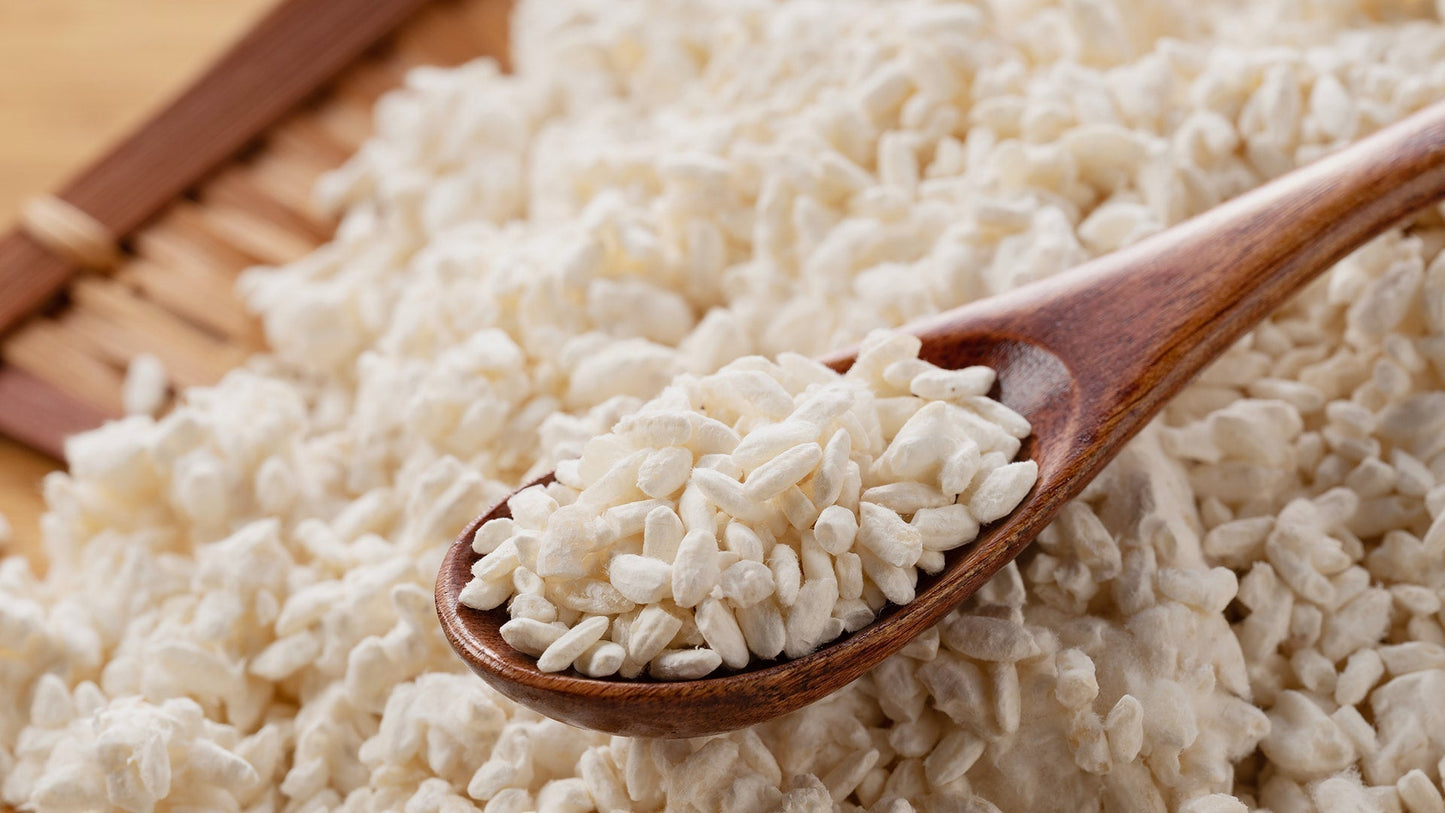
Japanese Dried Rice Koji — Additive-Free Malted Rice

Regular price $42.20
( / )
Retail price. Pro trade pricing after login. Shipping calculated at checkout.

Please allow at least 1 week for order processing and shipping. This may vary depending on seasonality and stock situation. For full details, see our Shipping Policy.

Additive-free dried rice koji from Niigata: pesticide-free rice, snow-cellar aged, traditional koji mold. The base for miso, shio koji, and amazake.

Koji is the starting point of Japanese fermentation. Steamed rice cultured with koji mold (Aspergillus oryzae) becomes the enzymatic engine behind miso, shio koji, amazake, soy sauce, mirin, and sake — the ingredient that converts starch into sugar and protein into amino acids, creating umami where there was none.

This dried rice koji is made from rice grown in Niigata without pesticides or chemical fertilizer. After harvest the rice is held by Yukigura Shikomi — stored in snow cellars that maintain a steady temperature and humidity year-round, so the grain retains its harvest-time freshness well into the warmer months. The koji itself is cultured by a long-established Japanese miso house working from a recipe over a century old, which gives the grain a deeper, more rounded koji character.

Drying makes it practical for a working kitchen. Fresh koji has a short life and must be used within days; dried koji keeps for months at room temperature and rehydrates readily on contact with warm water, so a chef can hold it as a pantry staple and pull it when a ferment is scheduled rather than on the koji’s schedule.

The ingredient list is two lines: rice and koji mold. No salt, no additives. What it contributes is enzymatic activity and a clean, subtly sweet aroma — the raw material for fermentation and seasoning, not a finished seasoning. Dried Rice Koji is the same product sold as Japanese Dried Rice Koji on our pages.

No additives. No salt. Made in Japan.

Rice (grown in Japan), koji mold (Aspergillus oryzae).
Made in Japan.

No additives, no salt. No allergens present in the product.
Produced in a facility that also handles wheat, soy, sesame, peanut, walnut, almond, cashew, pistachio, banana, apple, orange, and kiwi.

800g / 28.2 oz (1-pack) — pantry format. Available to professional buyers and home cooks.

Rice cultured with koji mold; dried for shelf stability. Rehydrates with warm water.

For orders larger than a single case, please contact us.

Dried Rice Koji is a raw fermentation ingredient, not a finished seasoning. Rehydrate or combine it according to the ferment or seasoning you are building.
The two foundational preparations — shio koji and amazake — are below, followed by direct applications.

**Shio koji (salt koji):** Combine dried koji, salt, and water at roughly 100g koji : 30g salt : 130g water. Hold at room temperature for 7–10 days, stirring daily, until it develops a sweet aroma and the grains soften. Use as an all-purpose marinade and seasoning.

**Amazake (rice ferment):** Rehydrate koji in water and hold at 55–60°C (132–140°F) for 6–8 hours. The koji enzymes convert starch into sugars, creating a naturally sweet, non-alcoholic ferment. Use as a sweetener, a marinade base, or a drink.

#Application by dish
・**Miso:** The classic use. Combine with cooked soybeans and salt, then ferment. A higher koji ratio gives a sweeter, faster-maturing miso; less koji gives a darker, longer ferment.
・**Shio koji marinade:** Coat fish, poultry, or meat in finished shio koji before cooking. The protease activity tenderizes and deepens flavor — a standard pre-sear or pre-grill step.
・**Amazake for dessert and pastry:** Use amazake made from this koji as a natural sweetener in sorbet, custard, or batter, where its glucose carries flavor without refined sugar.
・**Quick koji-cured vegetables:** Toss julienned root vegetables or cabbage with shio koji for a fast pickle; the enzymes draw out water and build savory depth in hours.
・**Sake-kasu and home brewing:** Use as the saccharifying agent in small-batch sake and other rice ferments where amylase activity is needed to convert starch.
・**Soy koji and tamari-style ferments:** Culture alongside soybeans and wheat for shoyu-style ferments, where koji supplies the enzymes for a long brew.
・**Koji butter and dairy:** Blend rehydrated koji or amazake into softened butter or cream for a savory-sweet spread; the enzymes add roundness over a day in the fridge.
・**Onion koji and vegetable seasonings:** Ferment koji with grated onion (or tomato) for a vegetal umami paste used in place of stock or bouillon.
・**Fermented sweet bean paste and koji natto:** Use as the koji base for koji-driven sweet bean preparations and other plant ferments where a clean enzymatic base is wanted.
・**Direct enzymatic tenderizer:** Rehydrate and apply briefly to lean cuts as a short cure when a full shio koji batch is not on hand; rinse before cooking.

*Working note: koji enzymes are most active at 55–60°C (132–140°F) and are denatured above 70°C (158°F). For amazake and saccharification, hold below 70°C; for shio koji and miso, ferment at room temperature.*

Store in a cool, dry place away from direct sunlight, heat, and humidity.
After opening, seal tightly and refrigerate or freeze to preserve enzymatic activity.

Best before: 12 months from production date (minimum 4 months guaranteed on arrival).

No additives — the dried format itself maintains stability; refrigeration preserves enzyme strength after opening.